

The rainbow
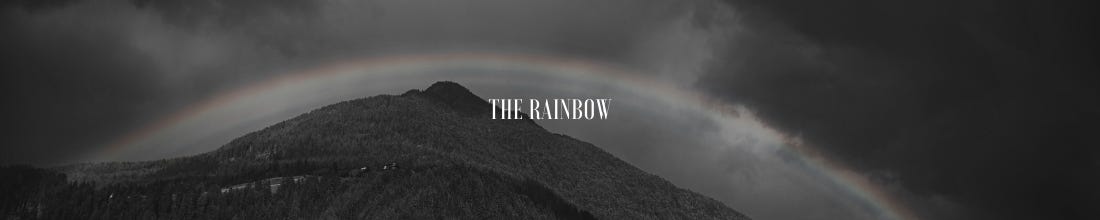
A promise in the midst of a gray world.

Today I will continue the series I began a few weeks ago about my favorite passages of Scripture. So far I have written about:
My favorite verse: Sorrow.
My favorite psalm: A matter of the heart.
My favorite miracle: Lord, I can’t.
My favorite question asked by God: Keep walking.
However, I still have many more favorite things in God’s Word, and today I will address another one of them: my favorite promise.
The Bible contains all kinds of promises made by God to humanity. Not all of them are the same: some are universal promises, others are personal, and others are conditional.
God promised Abraham that from his descendants he would make a great nation and that through him he would bless all the families of the earth.1
David was promised that his kingdom would not end with his life, but that his lineage would be established forever, pointing to an eternal King.2
To his people (and to us), God promised that He would no longer relate to them only through the law, but would give them a new heart, writing His law deep within their souls.3 He also promised us that everyone who puts their faith in Jesus would receive forgiveness, eternal life, and a restored relationship with Him.4
These are just some of the many promises we can find in the Scriptures.
However, my favorite promise isn’t any of them. Of course, the promise of salvation is undoubtedly the most important. But there’s one in particular that, in a vivid way, reminds us of God’s grace and mercy toward us.
It is found in Genesis 9:11-13, and it reads as follows:
“Yes, I am confirming my covenant with you. Never again will floodwaters kill all living creatures; never again will a flood destroy the earth.” Then God said, “I am giving you a sign of my covenant with you and with all living creatures, for all generations to come. I have placed my rainbow in the clouds. It is the sign of my covenant with you and with all the earth.” (NLT)
My favorite promise is:
God’s promise never again to destroy the world by means of a flood.
So, now I want to share with you why.
Genesis 6 tells us that the world was wayward, totally inclined to sin and evil, so God decided to do something about it.
“The Lord observed the extent of human wickedness on the earth, and he saw that everything they thought or imagined was consistently and totally evil. So the Lord was sorry he had ever made them and put them on the earth. It broke his heart. And the Lord said, ‘I will wipe this human race I have created from the face of the earth. Yes, and I will destroy every living thing—all the people, the large animals, the small animals that scurry along the ground, and even the birds of the sky. I am sorry I ever made them.’” (Genesis 6:5-7 NLT)
However, within that world full of evil and sin, there was one man who found favor in the eyes of God: Noah.
“But Noah found favor with the Lord.” (Genesis 6:8 NLT)
Therefore, God decided to save him and his family from the judgment that was about to happen on Earth. A judgment that was going to come through a flood.
To save his life, God ordered Noah to build an Ark, so that, in it, he, along with his family and a pair5 of every species of animal, could be protected from the flood.
Then God sent the flood upon the earth.
“When Noah was 600 years old, on the seventeenth day of the second month, all the underground waters erupted from the earth, and the rain fell in mighty torrents from the sky. The rain continued to fall for forty days and forty nights.” (Genesis 7:11-12 NLT)
It wasn’t just rain; it was perhaps the first rain that ever fell on Earth.
The madness of building the ark wasn’t just about the ship’s size or the animals; Noah was building an ark to face something no one had ever seen before. Something completely unknown to humankind.
There is really no clear evidence to suggest that it did not rain on Earth before the flood; however, the Bible says the following about it:
“This is the account of the creation of the heavens and the earth. When the Lord God made the earth and the heavens, neither wild plants nor grains were growing on the earth. For the Lord God had not yet sent rain to water the earth, and there were no people to cultivate the soil. Instead, springs came up from the ground and watered all the land.” (Genesis 2:4-6 NLT)
So, the earth was facing an unprecedented event; God’s purifying judgment was real and was manifesting itself in a catastrophic way.
“Finally, the water covered even the highest mountains on the earth, rising more than twenty-two feet above the highest peaks. All the living things on earth died—birds, domestic animals, wild animals, small animals that scurry along the ground, and all the people. Everything that breathed and lived on dry land died. God wiped out every living thing on the earth... The only people who survived were Noah and those with him in the boat.” (Genesis 7:19-23 NLT)
Okay. I want to pause here. This isn’t about the flood itself, but rather what happened afterward. So, let’s continue with that part of the story.
God’s judgment was carried out; the flood purified the earth. But then, after 150 days, the ark finally reached dry land.
“So the floodwaters gradually receded from the earth. After 150 days, exactly five months from the time the flood began, the boat came to rest on the mountains of Ararat.” (Genesis 8:3-4 NLT)
Now, this is where the imagination begins…
The world that existed when Noah and his family entered the ark was significantly different after their departure.
The Bible doesn’t describe the differences, and reading this story thousands of years later, I don’t think we fully understand them either. But I, at least, have many questions:
What did it smell like?
What did it look like?
What did those people feel when they finally left Mount Ararat6 and found themselves in an empty world?
What happened to all the bodies?
Perhaps many remained buried under the sediment. But I can’t help thinking that, at some point, someone found one while digging a well or planting crops.
I don’t know.
It was a world without noise. There were no strange voices, no neighbors, no even movement.
If I had to define it by a color:
It was a gray world.
Honestly, I don’t know if Noah and his family felt peace when they left the ark. But what I do know is that Noah trusted in God.
This is what the Bible says happened immediately after they left the ark:
“So Noah, his wife, and his sons and their wives left the boat. And all of the large and small animals and birds came out of the boat, pair by pair. Then Noah built an altar to the Lord, and there he sacrificed as burnt offerings the animals and birds that had been approved for that purpose. And the Lord was pleased with the aroma of the sacrifice and said to himself, ‘I will never again curse the ground because of the human race, even though everything they think or imagine is bent toward evil from childhood. I will never again destroy all living things. As long as the earth remains, there will be planting and harvest, cold and heat, summer and winter, day and night.’” (Genesis 8:18-22 NLT)
I imagine it wasn’t the most beautiful altar ever built. Perhaps the way the sacrifice was performed wasn’t the most orthodox. But at no point did God ask Noah for those sacrifices.
Noah left the ark and knew exactly what he had to do.
After that, God blessed Noah and made a covenant with him. God promised that He would never again destroy all life on earth with a flood.
If the day of Jesus Christ’s crucifixion was the darkest moment in human history, I’m sure the flood would be the second.
Two moments marked by death. Two moments when everything seemed lost.
However, after both of them there was a promise.
The sign of the promise in the New Covenant was the cross, while in the Noetic Covenant it was the rainbow.
In a gray world, God symbolized his faithfulness, grace, and mercy through a rainbow full of colors.
I don’t know if it’s the same for you, but seeing a rainbow usually makes me smile because it reminds me of this promise. It makes me stop, look up at the sky, and give thanks.
I find it hard to imagine that that wasn’t the most beautiful rainbow that ever existed. Not just because of its colors, but because of what it meant.
And I like to think that perhaps when Noah and his descendants looked up at the sky and saw a rainbow, they too felt peace and gave thanks.
Perhaps that’s why this is my favorite promise.
Because it reminds me that, even though everything around me looks gray, God is there to give it color.
If this thought spoke to you or encouraged you in any way, I’d love to hear from you in the comments.
And if you’re going through something and need prayer, I’m here. Feel free to send me a message.
If something you read here blesses you, encourages you, or draws you closer to Jesus—then it’s all been worth it. But, if you’d like to support me in a small way to continue writing, you can buy me a coffee. God bless you!
Genesis 12:2–3; 15:5; 17:4–7.
2 Samuel 7:12–16.
Jeremiah 31:31–34; Ezekiel 36:26–27.
John 3:16; 5:24; 10:28.
In the case of animals approved for eating and for sacrifice, there were seven pairs of each species (Genesis 7:2–3).
Located in the far east of Türkiye near the borders with Armenia and Iran, it is an inactive volcano and the highest peak in the country, reaching 5,137 m.a.s.l.